
“They want to silence us”: Catalan film director Isabel Coixet talks about what those who oppose the independence referendum feel
- Irene Hernandez Velasco
- BBC Mundo
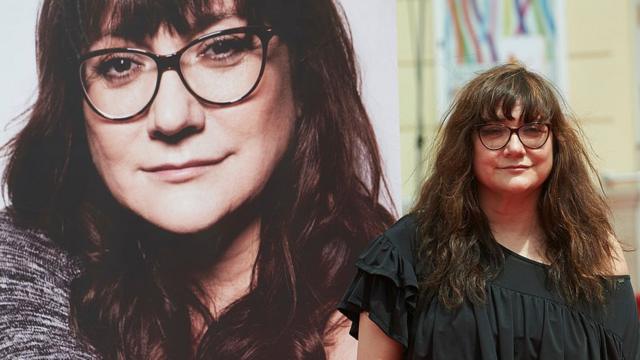
IMAGE SOURCE, GETTY IMAGES
Isabel Coixet (Barcelona 1960) is a renowned Catalan film director with numerous films and awards to her credit.
But, these days, it’s not his films that are making news.
The filmmaker, who has openly declared herself against the independence referendum held last Sunday in Catalonia, and who, along with almost a thousand artists and intellectuals who define themselves as ‘leftist’, signed a manifesto in which she called for the Catalan population not to participate in this consultation, denounces that it is being subjected to insults and harassment by some pro-independence supporters.
And he warns: “I would love to say that it is impossible for Catalonia to make the leap to physical violence, but at this moment anything can happen.”
BBC MUNDO spoke with her.
—————————————————————————————
You have repeatedly declared yourself against the independence referendum that was held last Sunday in Catalonia. Because?
Because, as has been confirmed, this referendum has been carried out in a Third World way: without control, with non-impartial and clearly pro-referendum international observers, without a census, without the minimum democratic guarantees… It has all been absurd.
You have reported having been verbally attacked and insulted for declaring yourself against the referendum…
Yes. It’s actually nothing new. These types of attacks began a long time ago, when I signed a manifesto promoted by several writers, sociologists and philosophers in which they only asked for real bilingualism in Catalonia.
All of us who signed that manifesto have been attacked and we have all been removed from Catalan public television. For the Catalan media, we do not exist. And all to say that for me bilingualism is a wealth…
I have studied in a bilingual Catalan/Spanish school, at home I spoke Catalan with my father and Spanish with my mother, who is from Salamanca. It is absurd that for defending a fantastic value such as bilingualism, articles are dedicated to you insulting you.
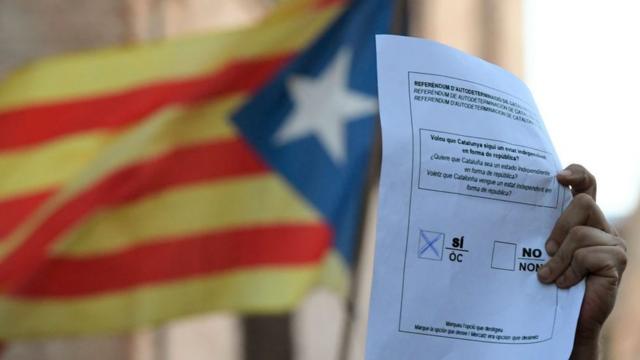
IMAGE SOURCE, GETTY IMAGES
A few days ago, while she was walking her dog in Barcelona, some young people scolded her in the street and called her a “fascist” for declaring herself against the referendum, even though you have always claimed to be left-wing. How did she feel?
At first I wasn’t even aware that they were insulting me, I couldn’t believe that those words were directed against me.
I was born during Franco’s time, my father has been an anti-Franco militant all his life. I started going to my first demonstrations and protests when I was 13 years old.
The first insults against me began ten years ago. The Catalan fundamentalist newspapers directed tremendous attacks at me when I declared myself in favor of bilingualism.
But although they had insulted me before, they had always done it behind my back. This time, however, they have done it head-on, which demonstrates the escalation of violence that we are experiencing.
Is Catalan society divided?
Yes, deeply. The writer Almudena Grandes said the other day that there is a double fracture, on the one hand between Catalonia and Spain and, on the other, within Catalan society itself, and I think she is right. It is a very difficult, terrifying situation.
Writers like Juan Marsé or Eduardo Mendoza, who are the essence of Barcelona, who in their books have narrated like no one else the ins and outs of this city, its soul, are now highlighted. They want to silence us.
I am aware that I am a privileged person, I can earn a living anywhere in the world, in Cartagena de Indias, in Arkansas, wherever.
But I wonder what those who are not as lucky as me will do. I am worried about all those Catalans who work here, who have their lives made here, who have their families here and who are being harassed.
This is a society that is committing suicide in slow motion. I have been denouncing it for years, I have been saying for a long time that we need to sit down and talk, but no one has listened to me.
IMAGE SOURCE, GETTY IMAGES
He is afraid?
No, I’m not afraid. But I know people who have it.
The part of Catalan society that is against independence and the referendum remains silent. Because?
Because there is great social pressure. The reality is that people have been silent for too long. She has kept silent because she does not want to make herself stand out in front of others, so as not to look bad at the school parents’ association meeting, so as not to disturb, so as not to harm her children, because they will not point her out, for fear of social isolation, because fear of losing their small benefits…
Many people have remained silent because they are not different, because what difference does it make? You have kept quiet for fear of small things, and now those things have become very big and are taking their toll.
Have you ever considered leaving Catalonia, moving to live somewhere else?
Yes, of course I’m considering it. I have lived halfway around the world, my partner is from New York. But I have always considered Barcelona my home, this is where my father grew up, where I have grown up. Every time I arrive in Barcelona and breathe the humid air of this city I feel at home.
Do you think the escalation of tension will continue?
Unfortunately, I think so. As I have already told you, neither on the part of the Spanish Government nor on the part of the Catalan Government do I see a real willingness to dialogue and resolve this situation. They are like roosters, let’s see who has the longest… So there will be more crying and more gnashing of teeth.
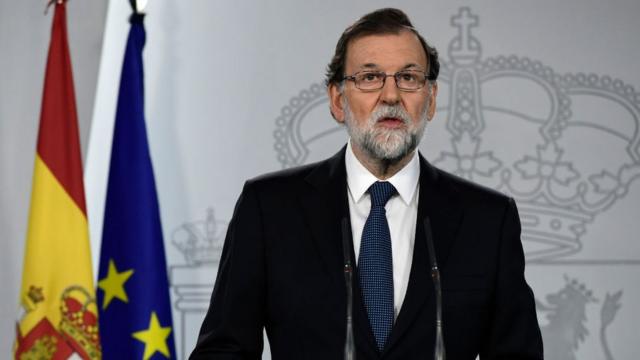
IMAGE SOURCE, GETTY IMAGES
Is it possible that verbal attacks could progress to physical attacks?
I don’t know, I really don’t know. I don’t even dare to think about it. These days I am rereading Stefan Zweig and I shudder, many of the things he says could have been written today.
I would love to be able to say no, that it is impossible for the leap to physical violence to happen, but at this moment anything can happen.
Can the situation still be recomposed?
A childhood friend of mine who just died always said that you have to negotiate with life and death until the last moment. So we must not give up, we must continue to aspire for all this to be resolved, it is possible to achieve it, even if it seems impossible right now.
Simply by lowering the tone a little and sitting down to talk it would be a lot.
The Catalan Government assures that 2.2 million citizens, of the more than 7.5 million that Catalonia has, participated in the consultation and that 90% voted in favor of independence. What do you think of that data?
If this referendum had been held in a third world country, the entire international community would have risen up to protest. Where are the people who have not voted or who have voted “no”? Is it possible that they are not taken into account?
I know many people who have gone to vote and who, despite having to do so surrounded by Catalan flags and in front of people clearly in favor of independence, have voted against it. The only publicity that has been done is that of the “yes”, an enormous amount of public money has been spent promoting the referendum.
Under these conditions, where is democracy? Where is freedom? I think I represent the majority of the people, and we have been put between a rock and a hard place.
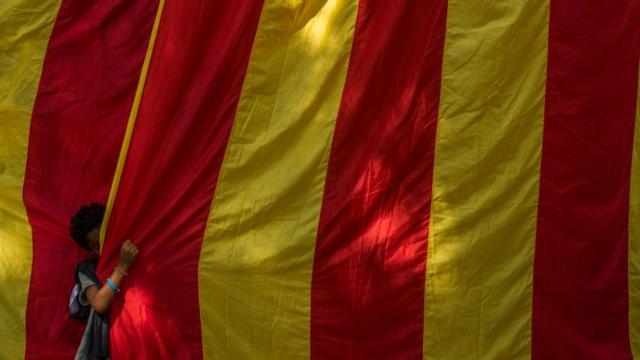
IMAGE SOURCE, GETTY IMAGES
But on the other hand it seems undeniable that there is a strong nationalist sentiment in an important part of Catalan society, don’t you think?
Of course there is, how could there not be? For years, the Catalan Government has been carrying out a campaign of victimization in which Madrid is systematically accused of all evils, in which “Spain steals from us” is constantly repeated. And if your Government says almost daily that Spain is robbing you, how can you not believe it?
I believe that one thing is the pride of belonging to a place and another is arrogance. I am proud to be from Barcelona, to be Catalan, to be Spanish, to be European. But what we are seeing is a problem of arrogance, of superiority.
Furthermore, a government is being confused with a country. I know quite a few people who in the referendum have voted not so much in favor of independence but against Mariano Rajoy; his vote has been a gesture of rejection of his government.
Now we have to think about how to solve this conflict, although to achieve it we have to want to resolve it and what I see is the two parties playing to see who has the longest time. But if this conflict is not resolved, it will explode.
Much of the international community has strongly condemned the use of violence employed by the Spanish police to try to prevent the holding of the referendum…
I also condemn her. She has been terrible, absolutely terrible. The central government has acted appallingly, but so has the Catalan government. The Catalan Government, as I have already told you, has been saying for years that “Spain steals from us”, and Spain responds by sending police officers to Catalonia and attacking people.
I dedicate myself to cinema and I know very well that images have a lot of power, while words are carried away by the wind. And the images that have gone around the world are those of those attacks.
The terrible thing is that there has never been a real desire on the part of the Catalan Government to undertake a negotiation, nor has there been any on the part of Madrid. What I wonder is who benefits from all this insecurity that we are experiencing, all this confusion.
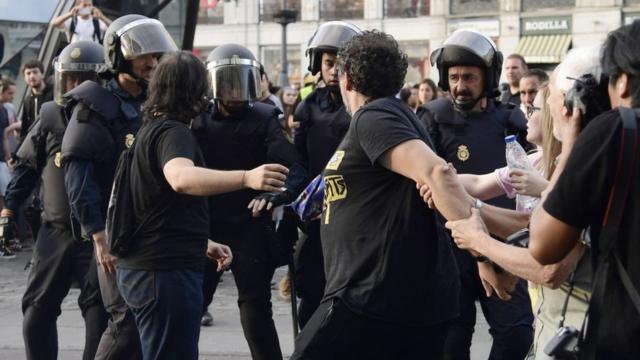
IMAGE SOURCE, GETTY IMAGES
Last Tuesday, the King of Spain, Felipe VI, addressed a harsh speech to the nation in which he described the Catalan Government as having “unacceptable disloyalty” and seeking to break the unity of the country. What did you think of his words?
I felt deep disappointment. Claiming legality is very good, but he did not say a word about the need to establish a dialogue between the two parties to end this situation.
That is the problem, the real big problem: neither of the two parties wants to dialogue, neither Madrid nor Barcelona.
What would be the solution then?
A commission of people who really want to fix this should be created. A commission of people who do not want to hang medals on themselves but rather put an end to this horrible conflict that is not good for anyone.
What will happen if next week the Catalan Government unilaterally declares the independence of Catalonia?
I don’t even want to think about it. Nobody who lives in Barcelona dares to think about it.
In the current situation, where do you find the strength to move forward?
In 2011 I made a documentary about Judge Garzón. It helps me to think about everything that happened and how he managed to overcome it without resentment and with a clean heart.
None of the things Garzón has been accused of has been proven, and yet he has been disqualified from continuing to serve as a judge.
I am lucky to be able to make films anywhere.